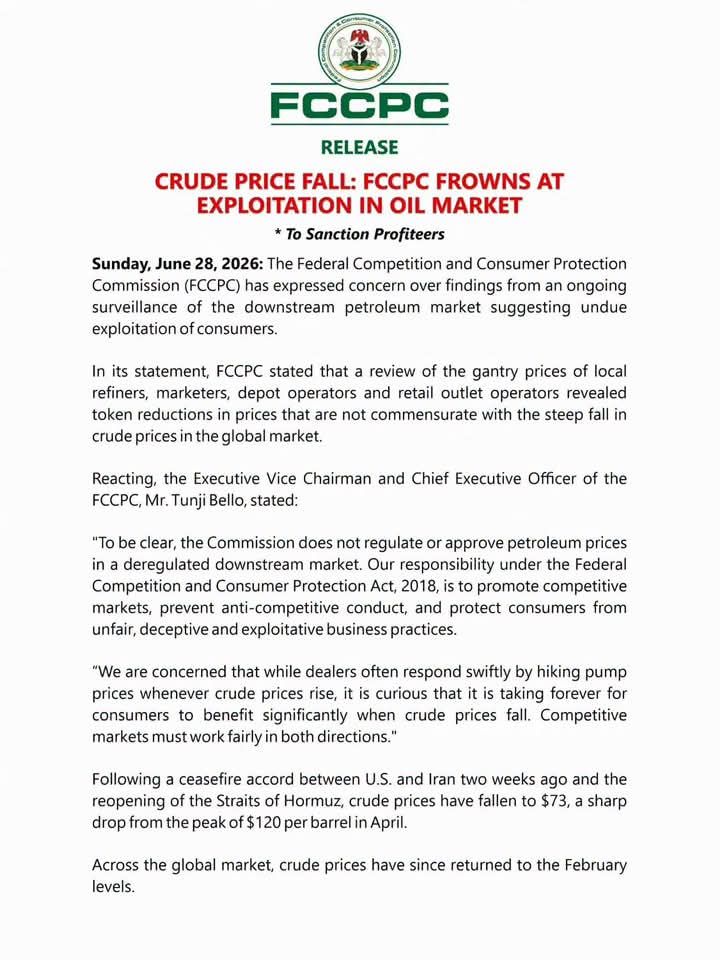
The Federal Competition and Consumer Protection Commission (FCCPC) has raised concerns over what it described as the exploitation of consumers in Nigeria’s downstream petroleum sector, warning that marketers found engaging in unfair pricing practices could face sanctions.
The Commission said findings from its ongoing surveillance of the downstream petroleum market revealed that reductions in gantry prices by local refiners, marketers, depot operators and retail outlet operators have been minimal despite the sharp decline in global crude oil prices.
The Executive Vice Chairman and Chief Executive Officer of the FCCPC, Mr. Tunji Bello, said the Commission was worried that consumers were not enjoying the benefits of falling crude prices.
“To be clear, the Commission does not regulate or approve petroleum prices in a deregulated downstream market. Our responsibility under the Federal Competition and Consumer Protection Act, 2018, is to promote competitive markets, prevent anti-competitive conduct, and protect consumers from unfair, deceptive and exploitative business practices,” Bello said.
He added that while marketers often increase pump prices promptly whenever crude oil prices rise, they have been slow to reduce prices despite the recent decline in the international market.
“We are concerned that while dealers often respond swiftly by hiking pump prices whenever crude prices rise, it is curious that it is taking forever for consumers to benefit significantly when crude prices fall. Competitive markets must work fairly in both directions,” he stated.
According to the FCCPC, global crude oil prices have dropped to about 73 dollars per barrel following a ceasefire between the United States and Iran and the reopening of the Strait of Hormuz, down from a peak of about 120 dollars per barrel recorded in April.
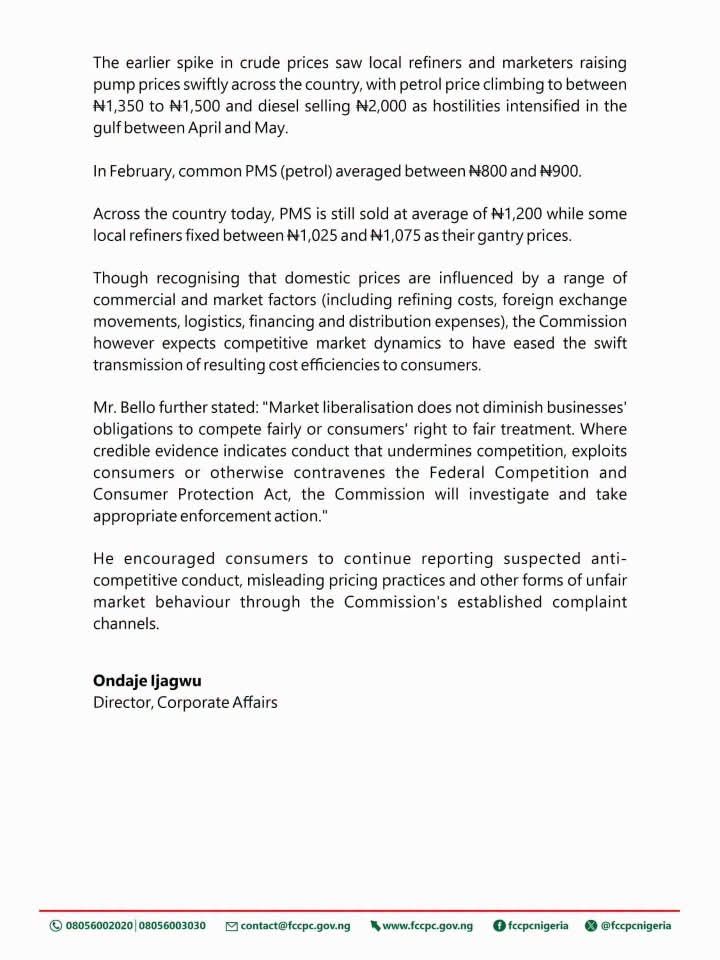
The Commission noted that although crude prices have returned to their February levels, retail fuel prices in Nigeria remain significantly higher than they were before the spike.
It recalled that petrol prices rose to between ₦1,350 and ₦1,500 per litre, while diesel sold for as much as ₦2,000 per litre during the period of heightened tensions in the Gulf between April and May.
In February, Premium Motor Spirit (PMS), also known as petrol, sold for between ₦800 and ₦900 per litre. However, the Commission observed that the product is currently sold at an average of ₦1,200 per litre nationwide, even as some local refiners have fixed gantry prices between ₦1,025 and ₦1,075 per litre.
The FCCPC said it would continue to monitor the market and take appropriate action against any operator found to be engaging in exploitative or anti-competitive practices that undermine consumer welfare.


Leave a Reply