From Fertiliser Distribution to Agro-Processing: How Sarafadeen Alli Is Supporting Agriculture in Oyo South
Maroof Asudemade
If there is one sector that offers perhaps the clearest opportunity to connect constituency representation with the everyday economic reality of the people, it is agriculture. For thousands of families across Oyo South, agriculture is not a political slogan. It is a source of livelihood, food and income. It is also an industry with the potential to create employment and stimulate rural development. This is why agriculture features prominently in the constituency intervention record of Senator Sarafadeen Abiodun Alli.
In Series I, we introduced the question: Has Senator Alli really done nothing for Oyo South, as his critics insist? In Series II, we examined the infrastructure interventions presented in his performance document, including solar streetlights and water-access projects.
This third instalment focuses on agriculture, and the interventions being presented as part of Senator Alli’s effort to support farmers, improve agricultural productivity and move farming beyond subsistence.
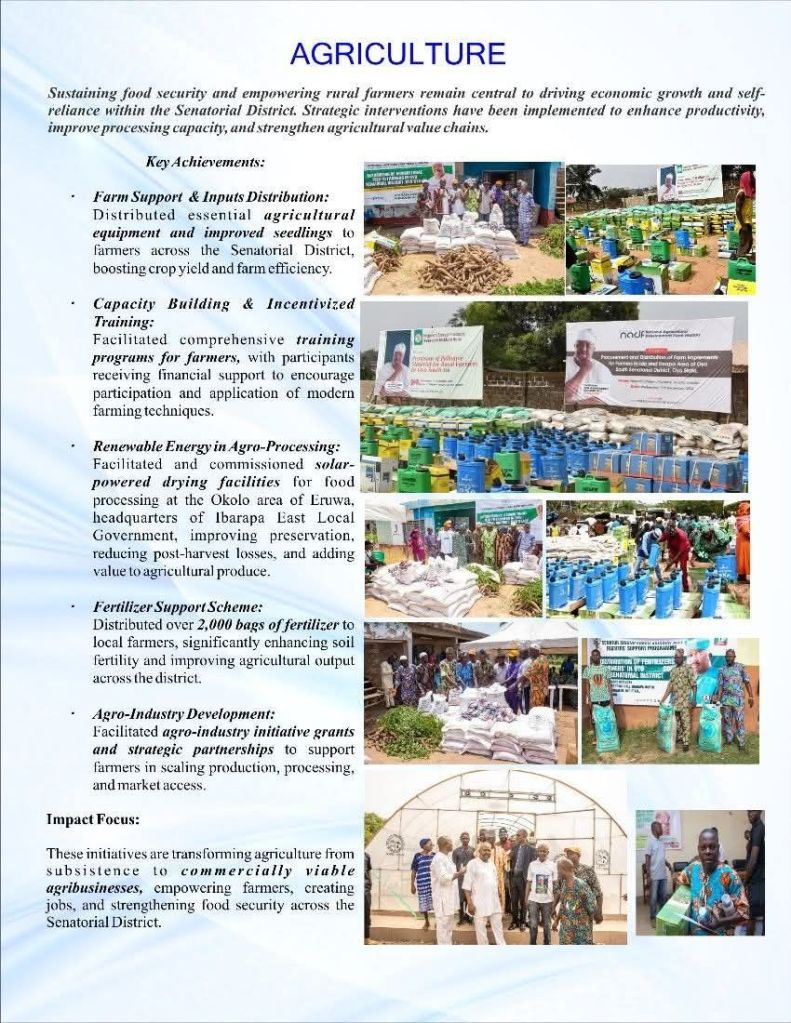
One of the key interventions listed is farm support and inputs distribution. According to the agricultural intervention identified, essential agricultural equipment and improved seedlings have been distributed to farmers across the Senatorial District. The objective is straightforward: boost crop yields and improve farm efficiency.
This is important because one of the major challenges facing smallholder farmers is the cost and availability of productive inputs. A farmer may have land and the willingness to cultivate it, but without good seedlings, appropriate equipment and other inputs, productivity can remain low. Therefore, support at the input level can make a meaningful difference to agricultural output. And this is not presented merely as a one-off distribution of food items. The intervention is specifically targeted at agricultural production.
The constituency record also identifies capacity building and incentivised training as another agricultural intervention. The document says comprehensive training programmes were facilitated for farmers, with participants receiving financial support to encourage participation and the application of modern farming techniques. This deserves attention. Agriculture cannot become commercially viable simply by distributing inputs. Farmers also need knowledge. Modern agriculture requires better understanding of:
* improved production methods;
* farm management;
* post-harvest handling;
* processing;
* marketing;
* productivity enhancement; and
* commercial opportunities within the agricultural value chain.
Training therefore complements input distribution. Give a farmer an input and you provide an immediate resource. Give the farmer knowledge and you potentially improve the way that resource is used.
Perhaps one of the more interesting interventions highlighted in the document is the use of renewable energy in agro-processing. It states that solar-powered drying facilities were facilitated and commissioned at the Okolo area of Eruwa, the headquarters of Ibarapa East Local Government. The stated purpose is to improve preservation, reduce post-harvest losses and add value to agricultural produce. This is significant because agricultural production does not end when a farmer harvests.
One of the persistent problems confronting farmers is what happens after harvest. Produce can be lost through inadequate storage, processing and preservation. When this happens, the farmer loses income while consumers ultimately bear part of the consequences through scarcity and higher prices. A solar-powered drying facility therefore represents an attempt to address a point further down the agricultural value chain.
It is not simply about growing more. It is about preserving more, processing more and potentially earning more from what is produced.
And there is another dimension: renewable energy. Using solar power for agro-processing potentially reduces dependence on conventional energy sources and can make processing facilities more practical in areas where electricity supply is unreliable.
There is also a fertiliser support scheme executed by SenatorSarafadeen Alli, under which more than 2,000 bags of fertiliser were distributed to local farmers. The stated objective was to enhance soil fertility and improve agricultural output across the district.
Fertiliser is one of the most basic agricultural inputs, and its cost can represent a significant burden for smallholder farmers. Consequently, subsidised or distributed fertiliser can reduce some of the production costs faced by farmers and potentially improve yields.
Again, however, the appropriate approach is to move beyond the photograph. How many farmers benefited? How was the fertiliser distributed? Which communities received it?What was the cost? What quantity went to each beneficiary? And, importantly, what has been the impact on production?
These are the questions that journalists, civil society organisations and constituents should be asking rather than helping oppositionnaysayers to wrongly allege that Senator Alli has done nothing.
The fifth agricultural intervention executed by Senator Alli is agro-industry development. Agro-industry initiative grants and strategic partnerships were facilitated to support farmers in scaling production, processing and market access. This may ultimately be one of the most important aspects of the agricultural programme.
The future of agriculture cannot be limited to planting and harvesting. The real economic opportunity lies in the value chain. A farmer who produces cassava, for example, should not necessarily have to sell raw cassava at the farm gate. There are opportunities in processing, packaging, transportation, storage and marketing. The same applies to maize, yam, vegetables, fruits and other agricultural products.
Moving farmers from subsistence farming towards commercially viable agribusinesses means creating opportunities for more people beyond the farmer himself. Processors need workers. Transporters move products. Marketers sell them. Packagers package them. Retailers distribute them. That is how agriculture can become an engine of local economic development.
The stated impact focus of Senator Alli’s agricultural interventions is particularly revealing. The initiatives are intended to transform agriculture from subsistence to commercially viable agribusinesses, while empowering farmers, creating jobs and strengthening food security across Oyo South. That is an ambitious objective.
And, as with every political claim, it should be tested against reality. Are farmers actually producing more? Are post-harvest losses declining? Are processing facilities functioning? Are beneficiaries expanding their businesses? Are new jobs being created?Are farmers gaining better access to markets? These are measurable questions. And they provide a much better basis for evaluating representation than political name-calling.
Here again, we return to the nickname being used by Senator Alli’s critics. If the argument is that his major achievement is the erection of billboards, then what do we make of interventions involving:
* improved seedlings?
* Agricultural equipment?
* Farmer training?
* More than 2,000 bags of fertiliser
* Solar-powered agro-processing facilities?
* Agro-industry grants and partnerships?
These interventions may be judged inadequate. They may be criticised for their scale. They may be subjected to questions about distribution and impact. Indeed, they should be subjected to scrutiny. But they cannot honestly be wished away by simply repeating that Senator Alli has done nothing.
Ultimately, the strongest validation of any agricultural intervention will not come from a glossy performance document. It will come from the farmers themselves. Did they receive the inputs? Did the seedlings perform? Did the fertiliser improve their farms? Did the training improve their farming practices? Did the processing facility help reduce losses? Did the intervention increase their income? Did the grants and partnerships help them reach larger markets?
These are the testimonies that should form the backbone of the final assessment. And since the answers are positive, those achievements deserve to be acknowledged. That is accountability.


Leave a Reply