Healthcare Beyond the Headlines: How Senator Sarafadeen Alli Is Bringing Medical Services Closer to Oyo South
By Maroof Asudemade
If representation is ultimately about improving the lives of the people, then healthcare must occupy a central place in measuring the performance of any elected representative. A road can make movement easier. A streetlight can make a community safer. Agricultural inputs can improve production. But when a constituent needs medical attention, access to quality healthcare can literally become a matter of life and death.
This is why the healthcare interventions contained in Senator Sarafadeen Abiodun Alli’s constituency performance document deserve to be examined as part of the continuing conversation about his representation of Oyo South Senatorial District.
The critics have called him “Senator Billboards.” But the question before us remains the same: Has he really done nothing? The healthcare record presented suggests otherwise.
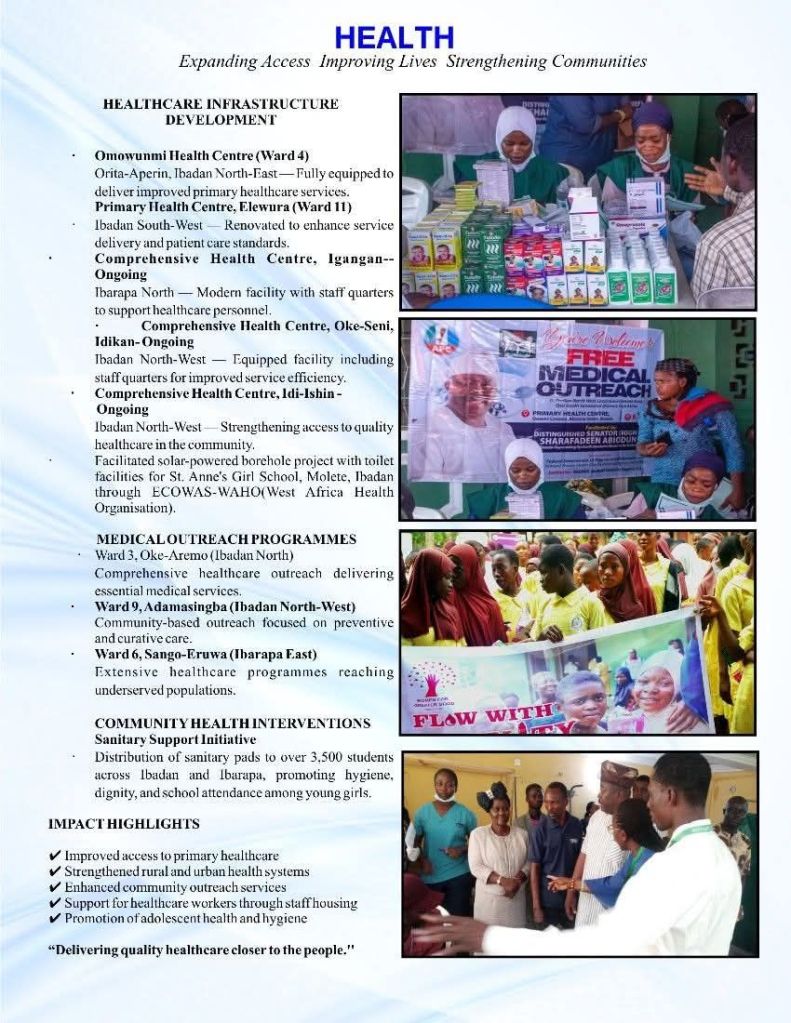
One of the most significant areas identified is healthcare infrastructure development. The document lists interventions involving health centres in different parts of the district, with attention to equipment, renovation, staff accommodation and improved service delivery. Let’s take the healthcare interventions one after the other.
1. Omowunmi Health Centre, Ward 4
At Orita-Aperin in Ibadan North-East, the Omowunmi Health Centre is listed as having been fully equipped to deliver improved primary healthcare services. This is important because primary healthcare is often the first point of contact between citizens and the health system. A health centre can only serve its community effectively when it has the necessary facilities and equipment.
2. Primary Health Centre, Elewura — Ward 11
The document also lists the Primary Health Centre, Elewura, Ibadan South-West, as having been renovated to enhance service delivery and patient-care standards. Renovation may not generate the same political excitement as commissioning a major new building, but improving an existing healthcare facility can directly affect the quality of the environment in which patients are treated.
3. Comprehensive Health Centre, Igangan — Ongoing
In Igangan, Ibarapa North, the document lists an ongoing Comprehensive Health Centre, described as a modern facility with staff quarters intended to support healthcare personnel. The inclusion of staff quarters is particularly noteworthy.
Healthcare infrastructure is not simply about putting up walls and installing equipment. Personnel must also be available to provide the service. Accommodation can therefore form part of an attempt to make rural healthcare facilities more attractive and functional for health workers.
4. Comprehensive Health Centre, Oke-Seni — Ongoing
Another ongoing project is identified at Oke-Seni, Ibadan North-West. The document describes it as an equipped facility, including staff quarters, with the objective of improving service efficiency. Again, the emphasis is on both infrastructure and personnel support.
5. Comprehensive Health Centre, Idi-Ishin — Ongoing
At Idi-Ishin, Ibadan North-West, another comprehensive health centre is listed as an ongoing intervention aimed at strengthening access to quality healthcare in the community.
Taken together, these projects indicate that the healthcare interventions are not concentrated in a single community. They span different parts of the Senatorial District.
Another intervention highlighted in the document deserves special attention. It states that a solar-powered borehole project with toilet facilities was facilitated for St. Anne’s Girls School, Molete, Ibadan, through ECOWAS-WAHO (West Africa Health Organisation). This brings together three important issues: water, sanitation and adolescent health.
For a girls’ school, reliable water and appropriate sanitation facilities are not luxuries. They are basic requirements for hygiene, dignity and a healthy learning environment. This intervention therefore extends the healthcare conversation beyond hospitals and clinics. Sometimes, public health begins with clean water and adequate sanitation.
The constituency document also records medical outreach programmes in different wards.
* Ward 3, Oke-Aremo — Ibadan North
A comprehensive healthcare outreach is listed for Ward 3, Oke-Aremo, providing essential medical services.
* Ward 9, Adamasinba — Ibadan North-West
Another community-based healthcare outreach is listed at Ward 9, Adamasingba, with a focus on preventive and curative care.
* Ward 6, Sango-Eruwa — Ibarapa East
The document also records an extensive healthcare programme in Ward 6, Sango-Eruwa, specifically targeting underserved populations.
These outreaches are important because healthcare access is not determined solely by the existence of a hospital. Distance, cost and awareness can all prevent people from seeking medical attention. Taking medical services directly into communities can therefore help bridge some of those gaps.
Perhaps one of the most socially significant interventions listed under community health is the sanitary-support initiative. According to the document, sanitary pads were distributed to more than 3,500 students across Ibadan and Ibarapa. The stated objectives are: promoting hygiene; preserving dignity; and encouraging school attendance among young girls.
This is an intervention that sits at the intersection of health, education and social welfare. For adolescent girls, access to appropriate menstrual hygiene materials can affect their comfort, confidence and ability to participate fully in school activities. It may appear small compared with the construction of a health centre. But public representation should also be about identifying real problems that affect people’s daily lives and responding to them.
The document identifies five broad impact areas:
* Improved access to primary healthcare.
* Strengthened rural and urban health systems.
* Enhanced community outreach services.
* Support for healthcare workers through staff housing.
* Promotion of adolescent health and hygiene.
These objectives paint a picture of a healthcare intervention strategy that attempts to operate at different levels—from physical health infrastructure to community outreach and preventive health. The stated philosophy is simple:
“Delivering quality healthcare closer to the people.”
It is important to repeat something that has been a recurring principle throughout this series. Listing projects is not the same thing as proving their impact. The projects should be independently verified. The ongoing health centres should be inspected. The renovated facilities should be visited. The equipment should be accounted for. The beneficiaries of the medical outreaches should be identified where appropriate. And the more than 3,500 students said to have benefited from the sanitary-pad initiative should, where possible, be independently verified.
These are the right steps to take to confirm the great works Senator Alli has been doing in Oyo South. It is accountability. The critics may continue to call him “Senator Billboards.” That is their political unreasonability.
But when the conversation moves from social media and political banter to documented interventions, the picture becomes more complicated. We now have a constituency record presenting:
* Healthcare centres equipped.
* Health facilities renovated.
* Comprehensive health centres under construction.
* Staff quarters being provided.
* Medical outreaches conducted in communities.
* A solar-powered borehole and toilet project for a girls’ school.
* Sanitary pads distributed to more than 3,500 students.
Again, the question is not whether these interventions are enough. Oyo South has enormous needs. No Senator, regardless of political party, can solve all the problems of such a large constituency through constituency projects alone. The legitimate question is whether these interventions represent meaningful efforts at constituency representation. On the evidence contained in this document, it would be difficult to maintain, without qualification, that nothing has been done.
This is perhaps the most important point in this entire series. When Senator Teslim Folarin was attacked in 2022 with the allegation that he had achieved nothing as a Senator, those of us who disagreed with the claim did not believe the appropriate response was to declare him perfect. We simply insisted that his record should be examined.
The same principle should apply to Senator Sarafadeen Alli. If his supporters exaggerate his achievements, they should be challenged. If his critics exaggerate his failures, they should equally be challenged. Political accountability must work in both directions. The opposition has said Senator Alli has done nothing for Oyo South. There are documentary evidences that point otherwise. Senator Sarafadeen Alli has been vindicated.


Leave a Reply