– 5,000 Solar Streetlights, Boreholes and the Infrastructure Footprint of Senator Sarafadeen Alli
By Maroof Asudemade
In the first part of this series, I established the reason for putting the record of Senator Sarafadeen Abiodun Alli’s representation of Oyo South before the public. The spurious charge against him is simple: “He has done nothing.” The more colourful version is that he is merely “Senator Billboards.”
But when the allegation is weighed against the constituency interventions executed by the Senator, a rather different picture begins to emerge.
This second instalment focuses specifically on infrastructure, and, in particular, two major areas are identified: solar streetlighting and water-access projects.
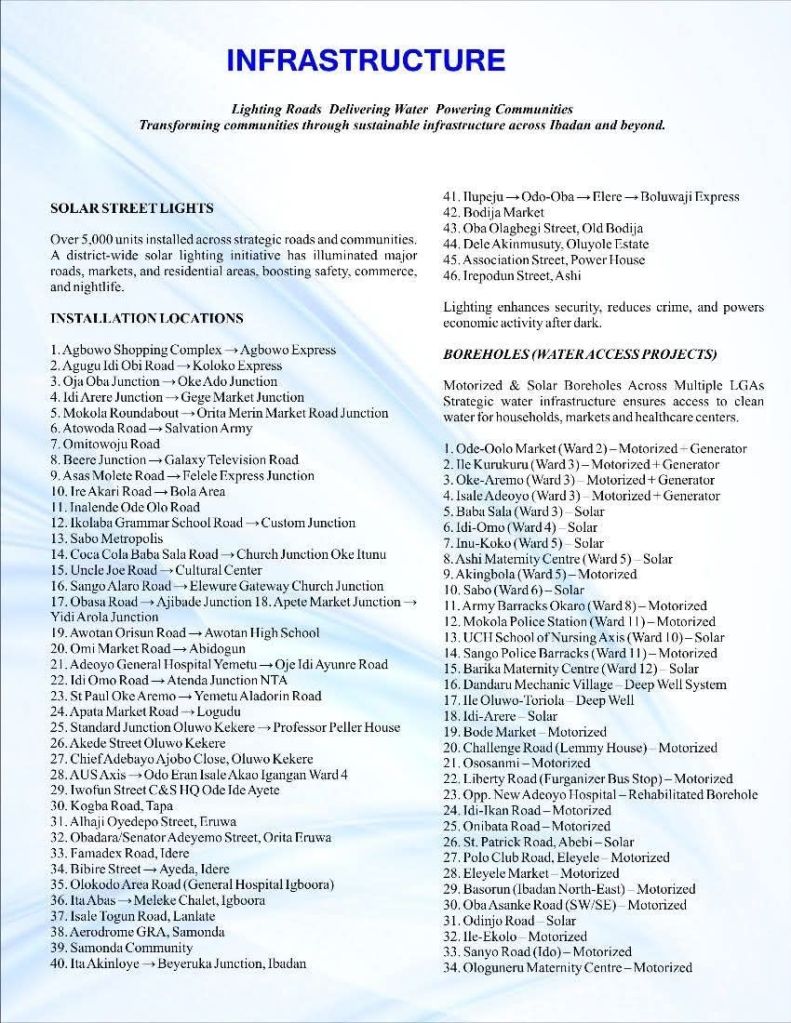
According to the number of the identified constituency projects, over 5,000 solar streetlight units have been installed across strategic roads and communities. The stated objective is not merely illumination. The intervention is presented as an attempt to improve security, commerce and night-time economic activity, while making major roads, markets and residential communities safer after dark.
This is arguably one of the more visible forms of constituency intervention because, unlike a speech or political promise, a functioning streetlight is something residents can physically see every night. And the list supplied is extensive.
Among the locations listed for the solar streetlight intervention are:
1. Agbowo Shopping Complex–Agbowo Express
2. Agugu Idi Odo Road–Koloko Express
3. Oja Oba Junction–Oke Ado Junction
4. Idi Arere Junction–Gege Market Junction
5. Mokola Roundabout–Orita Merin Market Road Junction
6. Atowoda Road–Salvation Army
7. Omitowoju Road
8. Beere Junction–Galaxy Television Road
9. Asas Molete Road–Felele Express Junction
10. Ire Akari Road–Bola Area
11. Inalende–Odo Road
12. Ikolaba Grammar School Road–Custom Junction
13. Sabo, and several other locations in Ibadan
14. Apata Market Road–Logudu
15. Standard Junction Oluwo Kekere–Professor Peller House
16. Akede Street, Oluwo Kekere
17. Chief Adebayo Ajobo Close, Oluwo Kekere
18. AUS Axis–Odo Eran Isale Akao
19. Iwofin Street–C&S HQ, Ode Ide Ayete
20. Kogba Road, Tapa
21. Alhaji Oyedepo Street, Eruwa
22. Obadara/Senator Adeyemo Street, Orita Eruwa
23. Famadex Road, Idere
24. Bibire Street–Ayeda, Idere
25. Olokodo Area Road, Igboora
26. Ita Abas–Meleke Chalet, Igboora
27. Isale Togun Road, Lanlate
28. Aerodrome GRA, Samonda
29. Samonda Community
30. Ita Akinloye–Beyeruka Junction, Ibadan
The streetlighting intervention continues with locations including Ilupeju–Odo-Oba–Elere–Boluwaji Express, Bodija Market, Ologbagi Street in Old Bodija, Dele Akinmusuti in Oluyole Estate, Association Street/Power House and Irepodun Street in Aši. This is indeed a considerable geographical spread.
Ours is a society where responsible political journalism fails to draw the line between reporting a claim and independently validating it. There have been over 5,000 units of streetlights installed. That figure should be independently verified. The locations should be visited. The number of poles installed should be counted. Their functionality should be checked. And the appropriate government and legislative records should be examined.
But that is precisely the point: the existence of a project cannot reasonably be dismissed simply because its promoter is a politician one does not support. If there are questions about the quality, quantity, funding or functionality of the lights, let those questions be asked. If there are shortcomings, let them be exposed. But let the debate be about the actual projects, rather than the convenient political refrain that nothing has been done.
The second major infrastructure intervention executed by Senator Sarafadeen Alli is water access. Under the heading “Boreholes (Water Access Projects),” the document of his achievements says motorised and solar boreholes have been provided across multiple local government areas. The stated objective is to provide access to clean water for households, markets and healthcare centres.
The listed projects include the following:
1. Ode-Oolo Market (Ward 2) — Motorised + Generator
2. Ile Kurukumu (Ward 3) — Motorised + Generator
3. Oke-Aremo (Ward 3) — Motorised + Generator
4. Isale Adeoyo (Ward 3) — Motorised + Generator
5. Baba Sala (Ward 3) — Solar
6. Idi-Omo (Ward 4) — Solar
7. Inu-Koko (Ward 5) — Solar
8. Aši Maternity Centre (Ward 5) — Solar
9. Akingbola (Ward 5) — Motorised
10. Sabo (Ward 6) — Solar
11. Army Barracks Okaro (Ward 8) — Motorised
12. Mokola Police Station (Ward 11) — Motorised
13. UCH School of Nursing Axis (Ward 10) — Solar
14. Sango Police Barracks (Ward 11) — Motorised
15. Barika Maternity Centre (Ward 12) — Solar
16. Dandaru Mechanic Village — Deep Well System
17. Ile Oluwo–Toriola — Deep Well
18. Idi-Arere — Solar
19. Bode Market — Motorised
20. Challenge Road (Lemmy House) — Motorised
21. Ososami — Motorised
22. Liberty Road (Vulcanizer Bus Stop) — Motorised
23. Opposite New Adeoyo Hospital — Rehabilitated Borehole
24. Idi-Ikan Road — Motorised
25. Onibata Road — Motorised
26. St. Patrick Road, Abebi — Solar
27. Polo Club Road, Eleyele — Motorised
28. Eleyele Market — Motorised
29. Basorun, Ibadan North-East — Motorised
30. Oba Asanke Road, Ibadan South-West/South-East — Motorised
31. Odunjo Road — Solar
32. Ile-Ekolo — Motorised
33. Sanyo Road, Ibadan — Motorised
34. Ologuneru Maternity Centre — Motorised
Again, the document presents these as interventions designed to address a very basic but important need: water. And this is an area where constituency representation can have a direct effect on everyday life. A borehole in a market can serve traders. A water project at a maternity centre can serve expectant mothers and healthcare workers. A project around a police barracks can support personnel and their families. A functioning water system in a community can save residents the time and expense of searching for water elsewhere.
These may not make as dramatic a political headline as a major highway. But to the person who has to fetch water every morning, access to water is development.
There is an interesting irony in the “Senator Billboards” nickname. A billboard is essentially a message about performance. A solar streetlight is physical infrastructure. A borehole is physical infrastructure. A medical outreach is service delivery. Agricultural inputs are economic intervention. Capacity-building programmes are human-capital development. So perhaps the most productive response to the “Billboards” accusation is not another billboard. It is to put the projects on the table and invite scrutiny.
This series is therefore not saying that Senator Sarafadeen Alli should be above criticism. Far from it. A Senator must be held accountable for the quantity, quality, distribution and impact of constituency interventions. If 5,000 solar lights are claimed, the public deserves to know where they are. If 34 water-access projects are claimed, the public deserves to know their locations and current condition. If projects have failed, that should be reported. If some have been abandoned, that should be reported. If they are functioning and serving communities, that should also be reported. That is what an honest assessment of representation requires not a round political calumny that will crumble under the weight of empirical evidence.


Leave a Reply