– Senator Sarafadeen Alli and the Records of Representation in Oyo South
By Maroof Asudemade
I remember vividly when Oloye Teslim Folarin was the Oyo State APC governorship candidate in 2022. One of the most persistent weapons deployed against his candidacy was the claim that, as a Senator representing Oyo State, he had achieved nothing. At the time, I was among those who took up the challenge of putting the record straight. We went beyond political rhetoric to highlight the legislative interventions, constituency projects and other initiatives associated with Senator Folarin’s tenure. He eventually lost the governorship election to Governor Seyi Makinde, but one thing was achieved: the lazy narrative that he had done “nothing” as a Senator could no longer stand unchallenged.
Today, the same script appears to be playing out again. Senator Sarafadeen Abiodun Alli, the APC governorship candidate in Oyo State, has become the latest target of the familiar political tactic. According to his critics, the Senator has achieved nothing for Oyo South Senatorial District. So persistent has the narrative become that he has even been mockingly christened “Senator Billboards”, with his traducers suggesting that the major thing he has done since becoming a Senator is erect billboards advertising his political ambition.
But politics, especially electoral politics, should not become a competition in who can shout the loudest. There is a record to examine. There are projects to interrogate. There are beneficiaries to identify. And there is a performance document to put before the public. That is the purpose of this series. This is not an attempt to claim that Senator Alli has solved every problem in Oyo South. No serious assessment of public office should make such a claim. Neither is it an argument that every project associated with a legislator should automatically be regarded as a personal gift to constituents.
Rather, it is an attempt to place what has been done on record, so that voters can make their judgments from facts rather than political slogans.
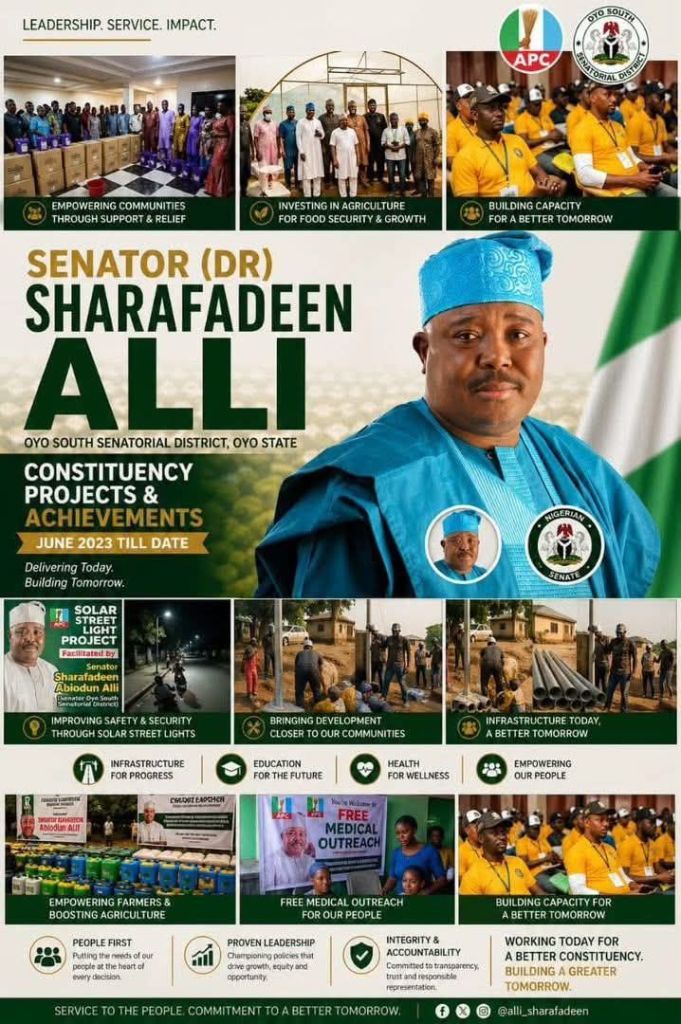
The constituency projects and interventions contained in the Senator’s performance document, covering June 2023 to date, cut across infrastructure, agriculture, healthcare, empowerment and human-capacity development.
One of the interventions highlighted is the provision of support and relief materials to communities. The published record shows beneficiaries gathered around supplies distributed under the Senator’s constituency intervention programme. For communities facing economic hardship, such interventions may appear modest when compared with major capital projects, but they address immediate needs and provide direct support to constituents.
The important question, therefore, is not whether such an intervention makes a good billboard. The question is: Were the materials provided? Who received them? And did they serve the intended beneficiaries? These are questions that can be independently verified.
Agriculture also features prominently in the constituency intervention. The document identifies initiatives aimed at investing in agriculture for food security and growth, alongside support for farmers and agricultural activities. Another component specifically highlights empowering farmers and boosting agriculture, with agricultural inputs displayed as part of the intervention. This is particularly significant in a district where agriculture remains an important part of the economic life of many communities.
A serious constituency representative should not only be concerned with what happens in Abuja. Representation must ultimately translate into interventions that touch the economic realities of the people back home. Support for farmers, therefore, belongs in the conversation about constituency representation.
The performance document also records a solar street-light project, described as an intervention facilitated by Senator Sarafadeen Abiodun Alli for Oyo South Senatorial District. Its stated objective is straightforward: to improve safety and security through solar street lights.
Street lighting is sometimes dismissed as too ordinary to constitute an achievement. Yet for communities that previously had poorly lit roads and streets, lighting can affect mobility, commercial activities and people’s perception of safety at night. Again, the appropriate standard is not political applause or political condemnation. It is verification:
Where are the lights? How many were installed? Which communities benefited? Are they functioning? Those are legitimate questions for the naysayers to find answers if they are sincere.
But to say that the intervention does not exist simply because one disagrees with Senator Alli politically would be to substitute political sentiment for evidence.
Another section of the document highlights infrastructure projects aimed at bringing development closer to communities. The accompanying photographs show construction work and the deployment of materials, including pipes. A further caption describes the intervention as:
“Infrastructure today, a better tomorrow.”
Infrastructure is perhaps one of the easiest areas in which constituency interventions can be objectively assessed. Roads, drainage, water infrastructure, street lighting and other physical projects leave footprints that citizens can see. The responsibility now lies with stakeholders, including journalists, civil society organisations and constituents, to go beyond the photographs and establish the precise locations, scope and status of these projects.
Healthcare is another pillar of the interventions listed. The document records a free medical outreach for the people, with photographs showing beneficiaries and healthcare-related activities. Free medical outreaches can provide an important bridge for people who might otherwise postpone basic medical attention because of cost or accessibility. Naysayers should look beyond the photograph, and find out the number of people attended to, services rendered, medicines provided, referrals made and the sustainability of the intervention. That’s better than political calumny. And that is how constituency representation should be evaluated.
Senator Alli’s constituency record also identifies capacity building as one of its intervention areas. The photographs show participants at a capacity-building programme, while the document describes the intervention as:
“Building capacity for a better tomorrow.”
This is important because political representation should not be reduced entirely to physical infrastructure. A constituency member can provide roads and street lights, but human capital development determines whether people can take advantage of economic opportunities. Training, skills acquisition and empowerment programmes therefore deserve to be included in any comprehensive assessment of a representative’s performance. And this exactly is what Senator Alli has done in his senatorial district.
Interestingly, the document groups Senator Alli’s interventions under four broad areas: Infrastructure for Progress; Education for the Future; Health for Wellness; and Empowering Our People. These are not insignificant categories. They represent the four areas in which the Senator’s constituency office has focused interventions since June 2023.
The scale of the interventions is sufficient for a first term senator and one that should be acknowledged honestly. Whether there are shortcomings is also a legitimate subject for scrutiny. But “he has done nothing” is a very spurious claim.
There is nothing wrong with criticising Senator Sarafadeen Alli. He is a public officer and, as the APC governorship candidate, an active political participant. His performance should be scrutinised. His projects should be audited. His promises should be tested against delivery. His legislative record should be examined. His impact on Oyo South should be compared with that of his predecessors and contemporaries.
But if the argument is that he has achieved nothing, then the burden of proof becomes considerably heavier. Because, from the constituency performance document before us, there are interventions in agriculture, healthcare, infrastructure, solar street lighting, relief/support and capacity building.
There is nothing wrong with criticising Senator Sarafadeen Alli. He is a public officer and, as the APC governorship candidate, an active political participant. His performance should be scrutinised. His projects should be audited. His promises should be tested against delivery. His legislative record should be examined. His impact on Oyo South should be compared with that of his predecessors and contemporaries.
But if the argument is that he has achieved nothing, then the burden of proof becomes considerably heavier. Because, from the constituency performance document before us, there are interventions in agriculture, healthcare, infrastructure, solar street lighting, relief/support and capacity building.
In subsequent series, I will begin to chronicle the individual projects — what they are, where they are located, who benefited, what evidence exists and, where possible, what government records say about them. This is necessary to counter the false narratives being peddled by the opposition that Senator Sarafadeen Alli has achieved nothing as a Senator.
Let’s evaluate his stewardship not by counting billboards but by counting projects; not by repeating allegations but byy examining evidence; and not by asking whether Senator Sarafadeen Alli has done everything. The more pertinent question is: what has he actually done, and how much has it impacted the people of Oyo South?


Leave a Reply