By Maroof Asudemade
There is something profoundly inconsistent, if not hypocritical, about Governor Seyi Makinde’s latest commentary on President Bola Tinubu’s journey to Saudi Arabia to perform Umrah and pray for Nigeria.
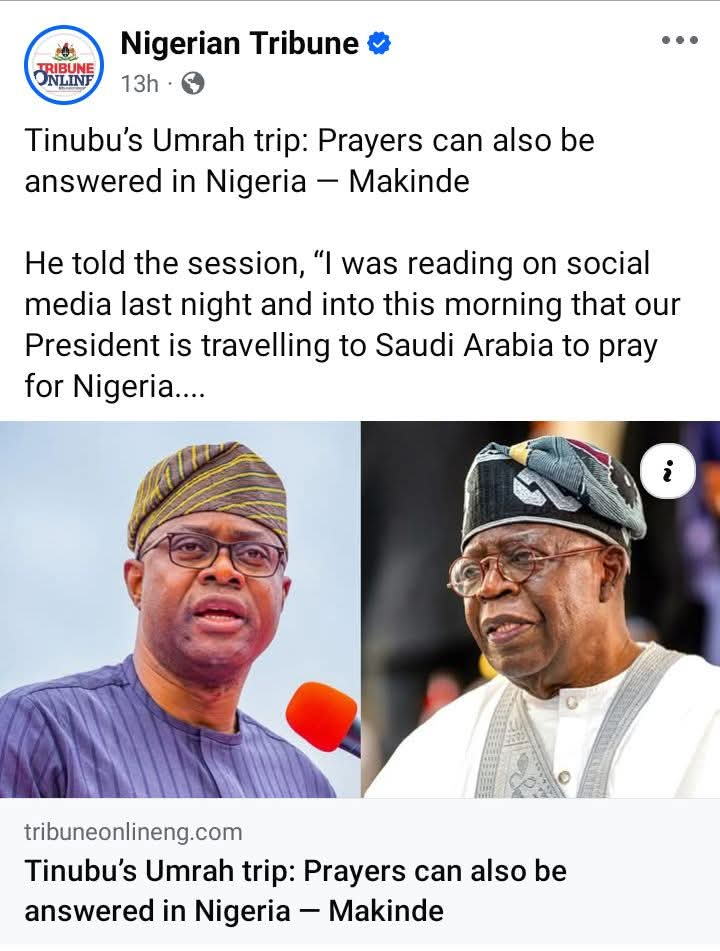
Reacting to the President’s trip, Makinde reportedly declared that prayers could also be answered in Nigeria and that Nigerians could remain at home to pray for the country and its leaders. He went further to suggest that Nigerians needed to know the true situation of things so that their prayers would not be in vain.
Ordinarily, nobody should quarrel with the religious belief that God answers prayers everywhere. But when such a statement comes from a governor whose administration has repeatedly sent pilgrims to Saudi Arabia and solicited prayers for his government, one is compelled to ask: When did Makinde suddenly discover that prayers could be answered in Nigeria?
Does the governor remember his own administration’s relationship with the annual Hajj pilgrimage?
On July 17, 2019, barely weeks after assuming office, Makinde personally bade farewell to 900 Oyo State pilgrims travelling to Saudi Arabia for Hajj. According to a Nigerian Tribune report published on that date, he specifically urged them to beseech Allah in Mecca for solutions to the numerous socioeconomic and political problems confronting Oyo State and Nigeria. He even appealed to them to pray for divine guidance for the nation’s leaders.
In June 2022, his administration announced arrangements for 779 Oyo State pilgrims to travel to Saudi Arabia for Hajj. The government also urged the pilgrims to pray for Nigeria during their spiritual exercise.
Again, in June 2024, Oyo State pilgrims offered special prayers for Makinde and his administration at Mount Arafat, asking Allah to grant him and his team the wisdom and strength to govern the state successfully. This was reported by Nigerian Tribune on June 15, 2024.
These are not mere allegations to debunk the governor’s statement. They are documented public records of the governor’s administration. So, what has changed? Were those pilgrims not travelling to Saudi Arabia to perform religious obligations and seek Allah’s intervention? Did Makinde not consider Mecca and Mount Arafat appropriate places to solicit divine intervention for Oyo State and Nigeria? Why was it acceptable for his administration to organise, support and encourage such journeys, but suddenly questionable when President Tinubu undertakes Umrah and announces his intention to pray for Nigeria? If prayers can be answered in Nigeria, why did Makinde repeatedly ask Oyo pilgrims to pray for his government in Saudi Arabia? Were the prayers offered in Ibadan, Ogbomoso or Oyo less effective?
Makinde is entitled to his political opinions, but he cannot rewrite his own administration’s history to score political points against a political opponent. There is a difference between demanding transparency from the President and disparaging the rationale of a religious journey. The governor should be careful not to turn a valid debate about governance into an exercise in selective indignation.
Ultimately, the question is simple: If Saudi Arabia was a worthy destination for Oyo pilgrims to seek Allah’s intervention for Makinde’s government and Nigeria, on what moral or intellectual grounds does he now question the President’s decision to go there to pray for the same country?
Leadership demands consistency. Political opposition demands responsibility. And public commentary demands intellectual honesty. Makinde continues to swim in his web of contradictions.


Leave a Reply