By Maroof Asudemade
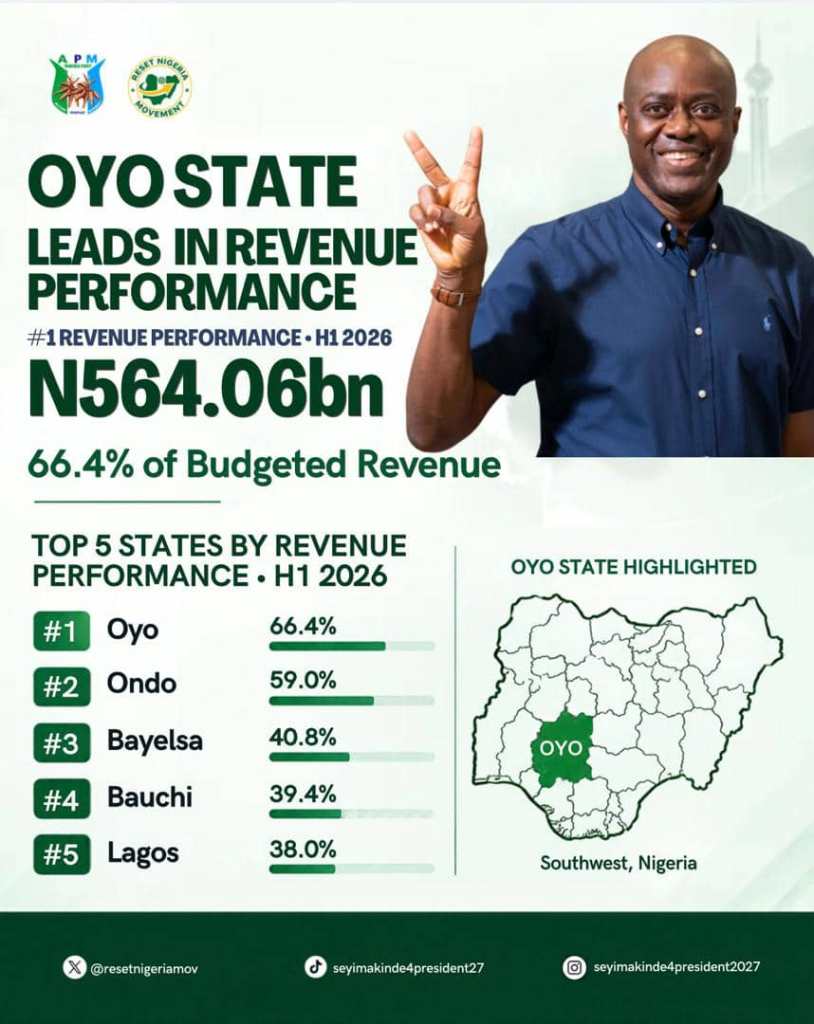
The political camp of Governor Seyi Makinde has gone into celebratory frenzy since the state’s reported 66.4 per cent revenue performance in the first half of 2026 has broken out. They regard the development as evidence of exceptional governance and, consequently, as a justification for projecting Governor Seyi Makinde as a potential president of Nigeria. Their argument is simple: if Makinde can generate impressive revenue and manage Oyo State’s finances, he can replicate the same feat at the federal level.
Unfortunately, this argument confuses revenue mobilisation with economic prosperity, budget performance with effective governance, and the administration of a state with the enormously more complex responsibility of governing a federation. While Oyo State’s reported performance against its budgeted revenue target deserves acknowledgement, it should not become an instrument for concealing the fundamental questions about the quality of governance, the condition of public institutions and the living circumstances of ordinary residents.
A government should not be judged primarily by how much money it reports generating, but by what that money accomplishes for the people. Revenue generation is not the same as economic prosperity. It must be pointed out at this juncture that the celebrated revenue performance is not only about what Oyo State generated internally under Governor Makinde. It combines accruals from the monthly federal allocation which actually form the bulk of the state’s revenue for the period under review. It is shocking that Makinde administration and his camp could hire drummers and dance around town over the increased revenue performance from mainly the federal source he refuses to acknowledge.
Despite the quadrupled increase in allocation to Oyo State from the federation account, Makinde continues to cry that Oyo people were hungry. How could Oyo people be hungry in the face of quadrupled increase in federal allocation and celebrated revenue performance? I don’t want to believe that Governor Makinde is suffering from bouts of confusion!
The first question the promoters of this Makinde’s presidential narrative must answer is straightforward: what tangible improvements have the people of Oyo State experienced in proportion to the government’s reported revenue performance? Has the state achieved a satisfactory level of public healthcare delivery? Are public schools adequately staffed? Has poverty been substantially reduced? Are rural communities enjoying quality infrastructure? Are ordinary households experiencing improved living standards? These are the questions that should accompany every celebration of revenue performance.
Let us consider the healthcare sector. An investigation published by the International Centre for Investigative Reporting (ICIR) in December 2024 documented severe personnel shortages across Oyo State’s primary healthcare centres. It reported that the state’s PHCs had fewer than 5,000 personnel against an estimated requirement of about 14,000. This is not a minor administrative inconvenience. It is a fundamental service-delivery problem.
A government may renovate hundreds of primary healthcare centres, install new roofs, paint their walls and provide modern-looking buildings. But without doctors, nurses, midwives, laboratory personnel and other essential healthcare workers, the facilities cannot deliver the services for which they were established.
The same concern applies to education. The Federal Ministry of Education’s 2024/2025 Annual School Census places Oyo State’s learner-teacher ratio at 41.8, compared with the national figure of 33.6. Its learner-classroom ratio is 86, against the national figure of 60.1. These figures raise serious questions about classroom congestion, teacher availability and the quality of the learning environment.
The implication is that budgetary allocations and expenditure achievements must be evaluated against the actual conditions in schools. A government cannot claim educational transformation simply because it has allocated substantial sums to the sector.
Poverty remains an important test of governance. Another important consideration is the poverty situation in Oyo State. The National Bureau of Statistics’ 2022 Multidimensional Poverty Index established that approximately 45.4 per cent of Oyo State’s population was multidimensionally poor. Although this is a historical baseline rather than a current 2026 measurement, it demonstrates the scale of the challenge that any responsible assessment of the state’s development must confront.
Multidimensional poverty goes beyond income. It includes deprivation in education, healthcare, living standards, sanitation, electricity and other essential necessities. The question, therefore, is not simply whether Oyo State has increased its revenue. It is whether the administration’s policies have substantially reduced these deprivations. Where are the measurable improvements in household purchasing power, employment opportunities, access to affordable healthcare, quality education and economic security?
A state cannot be declared economically prosperous merely because its government has achieved a high percentage of its projected revenue. The prosperity of government finances and the prosperity of citizens are two different things.
Infrastructure development is another area requiring a more critical assessment. There is no denying that the Makinde administration has undertaken road construction, rehabilitation and other capital projects. However, the existence of projects should not terminate the discussion about infrastructure performance. The relevant questions include the quality of construction, durability, geographical distribution, value for money, maintenance arrangements and the extent to which the projects address the needs of communities.
Oyo State is considerably larger than Ibadan. Development should therefore not be measured exclusively by visible projects within the state capital. Communities across Oke-Ogun, Ibarapa, Ogbomoso, Oyo and other parts of the state must also be considered. A road project is not necessarily evidence of sustainable infrastructure development if its quality, maintenance and long-term economic usefulness are questionable.
Similarly, the construction of public buildings does not automatically translate into improved public services. The standard should be functional infrastructure that improves productivity, reduces the cost of doing business and enhances the quality of life.
The debt sustainability question cannot be ignored. Perhaps one of the most important issues in evaluating the state’s financial management is debt sustainability. The Oyo State Government’s own Medium-Term Expenditure Framework for 2025–2027 contained debt sustainability indicators that deserve attention. Its debt position as at December 2023 showed domestic debt of approximately ₦160.54 billion and external debt of approximately ₦57.41 billion, bringing total public debt to approximately ₦217.95 billion.
More importantly, the state’s domestic debt-to-internally generated revenue ratio stood at 313.28 per cent, against a stated sustainability threshold of 150 per cent. Its domestic debt-service-to-IGR ratio was 34.48 per cent, against a threshold of 15 per cent. The document itself advised against further domestic borrowing because the relevant threshold had been exceeded. Yet, Makinde has taken loans running into 400 billion naira this year alone.
The Debt Management Office subsequently reported Oyo State’s domestic debt stock at approximately ₦80.28 billion as of September 30, 2025. This is a different reporting period and debt measure, and should not be confused with total public debt. The important point is that revenue performance must be assessed alongside debt obligations, debt servicing, recurrent expenditure and the government’s capacity to finance future development without placing an excessive burden on future administrations. Generating more revenue does not automatically establish fiscal sustainability. The federal presidency is not an extension of a state government.
Beyond the question of Oyo State’s development record, there is another fundamental weakness in the argument that Makinde’s reported revenue performance qualifies him to become Nigeria’s president. The administration of a state and the governance of a federation are fundamentally different responsibilities. Nigeria is a complex federation of 36 states and the Federal Capital Territory, with diverse economic structures, security challenges, political interests, ethnic and cultural differences, fiscal responsibilities and constitutional obligations.
The president must coordinate national security, foreign relations, monetary and fiscal policy, international trade, energy security, national infrastructure, intergovernmental relations and the management of a federal bureaucracy. He must also navigate the National Assembly, the judiciary, state governments and several constitutionally independent institutions. The ability to achieve a particular revenue target in one state cannot, by itself, demonstrate the capacity to manage these responsibilities. Indeed, even within Oyo State, the questions surrounding healthcare personnel, educational standards, poverty, infrastructure quality and fiscal sustainability demonstrate why revenue figures should not be treated as a comprehensive measure of administrative achievement.
If the argument for Makinde’s presidential aspiration rests substantially on Oyo State’s 66.4 per cent revenue performance, then the argument requires considerably more evidence. Where is the comprehensive demonstration of improved public service delivery? Where is the measurable evidence of poverty reduction? Where are the indicators of stronger public institutions and sustainable infrastructure? How has the administration resolved the human-resource deficiencies affecting essential services?
A presidential ambition requires more than a revenue scorecard. There is nothing wrong with celebrating Oyo State’s revenue mobilisation efforts. Indeed, improved revenue generation is an important responsibility of every government. But there is something fundamentally incomplete about presenting a revenue achievement as an all-encompassing certificate of good governance.
A government exists primarily to serve the people, not to celebrate its balance sheets. The real test of leadership is the extent to which public resources are translated into opportunities, security, functional institutions, quality infrastructure, accessible healthcare, better education and improved living standards.
If public hospitals remain inadequately staffed, schools struggle with teacher and classroom shortages, poverty continues to affect a substantial section of the population, and debt management requires closer scrutiny, then the conversation about governance must extend beyond revenue statistics.


Leave a Reply