.By Maroof Asudemade
There is no shortage of reasons to be worried about Nigeria at 66. There is incidence of insecurity, poverty, unemployment, infrastructure deficits and the painful reality that millions of Nigerians still struggle to meet their basic needs. These challenges must neither be denied nor romanticised.
But as Nigeria marks 66 years of independence today, October 1, 2026, I disagree with the increasingly popular analogy that compares the Nigerian nation to a 66-year-old man who is still working but depends on his father for food. The analogy may sound clever, but it misunderstands the nature of nation-building.
It is not apt to compare the lifespan of a nation with the lifespan of a human being. A 66-year-old human being has passed through a biological process that is relatively predictable. Nations do not grow that way. Countries are built through institutions, education, industrialisation, infrastructure, political stability, technological advancement and successive generations of citizens and leaders.
Nigeria became an independent sovereign nation on October 1, 1960. But independence was not the completion of nation-building; it was the beginning of a new chapter in it. Consider the countries Nigerians routinely describe as “First World” today. The United States did not become the economic and technological power it is today merely because it attained independence in 1776. Its transformation was the product of generations of industrialisation, institution-building, expansion of infrastructure, technological innovation and economic development.
Britain’s rise as an industrial and global economic power was also the result of a process extending over centuries. France and Germany likewise went through long and often turbulent periods of political transformation, industrialisation, reconstruction and economic expansion. Germany, in particular, had to rebuild from the devastation of two world wars before becoming one of the world’s leading industrial economies.
So, what exactly is the rush to conclude that Nigeria has failed because she is 66? At 66, Nigeria is not a finished product. She is a nation still being built. Indeed, our history has not been a straight line of uninterrupted development. Independence was followed by political instability, military rule, civil war, economic crises and years of institutional disruption.
Nigeria’s First Republic itself lasted only from 1960 until the military coup of January 1966. That history matters when assessing where we are today. This does not mean Nigerians should accept mediocrity. Far from it. We must demand better governance, stronger institutions, greater accountability, security, jobs, quality education, reliable electricity, efficient healthcare and an economy capable of creating prosperity for ordinary citizens.
The kind of political system Nigeria adopts is not helpful for continuous growth and development of the country. Nations rarely develop rapidly within 4-year or 8-year election cycle. Most developed countries have stable government spanning 30 years or more to achieve rapid development. Regular change in government from one party to another hinders Nigeria’s development.
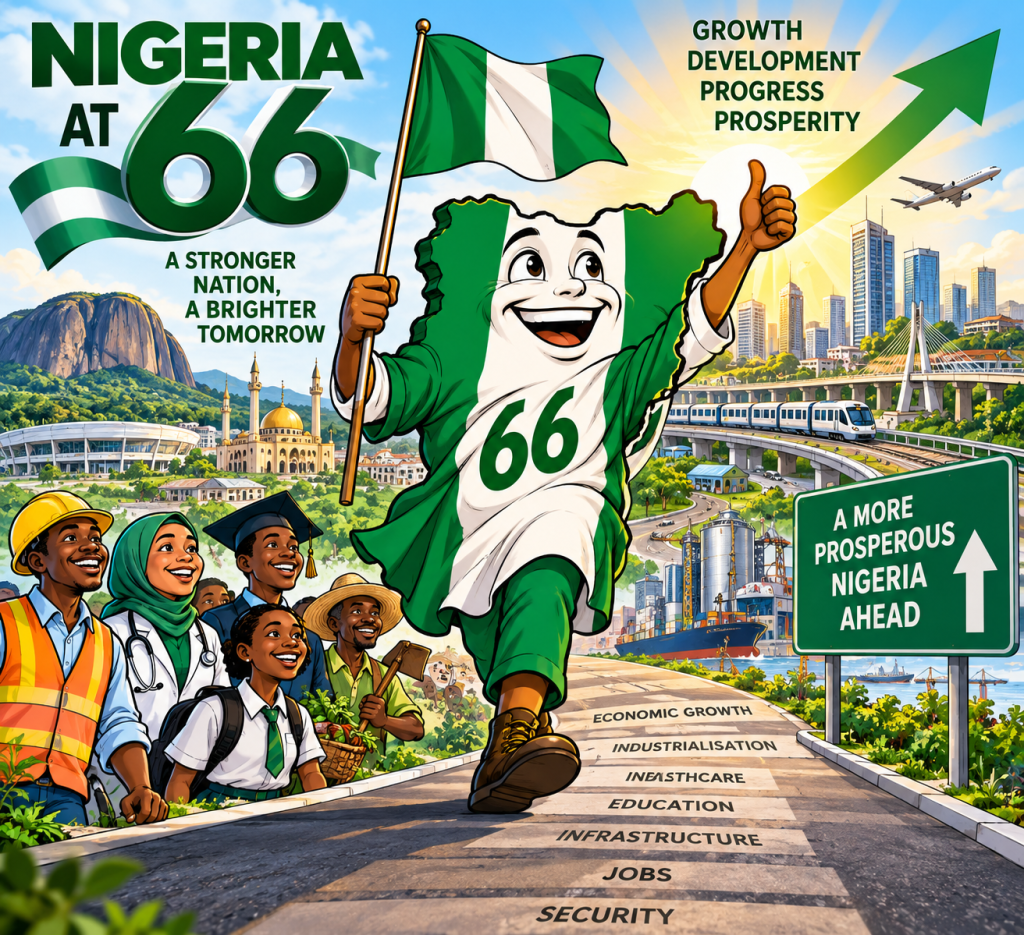
But criticism must coexist with perspective. There is also reason to believe that Nigeria is entering another important phase of its development. The economic reforms of President Bola Ahmed Tinubu’s Renewed Hope administration are aimed at restructuring the economy and creating the conditions for sustainable growth. The President’s 2026 Independence address itself places the administration’s programme in the context of moving “from reform to prosperity.” Whether these reforms ultimately deliver their full promise will be judged by measurable improvements in the lives of Nigerians.
That judgment belongs to history and, ultimately, to the Nigerian people. For now, however, there is nothing wrong with celebrating Nigeria while demanding more from her. We can acknowledge the failures without surrendering our faith in the country. We can criticise government without condemning the nation. We can recognise today’s difficulties while believing in tomorrow’s possibilities.
Nigeria at 66 is not an old man waiting for his father to feed him. 66 may be the average lifespan of Nigerians. 66 is not the average lifespan of Nigeria. Nigeria is a young nation in the long history of nations, still struggling, still learning, still building and still capable of greatness. So let us celebrate Nigeria not because everything is perfect, but because the journey continues.
Let us believe that the reforms now being pursued can return the country firmly to a path of growth, development, progress and prosperity.
Happy 66th Independence Anniversary, Nigeria. May the next chapter be better than the last.


Leave a comment