Maroof Asudemade
The decision of the Oyo State Signage and Advertisement Agency (OYSAA) to impose hefty campaign permit fees on candidates seeking elective offices raises serious questions about the government’s commitment to democratic fairness and political inclusion.
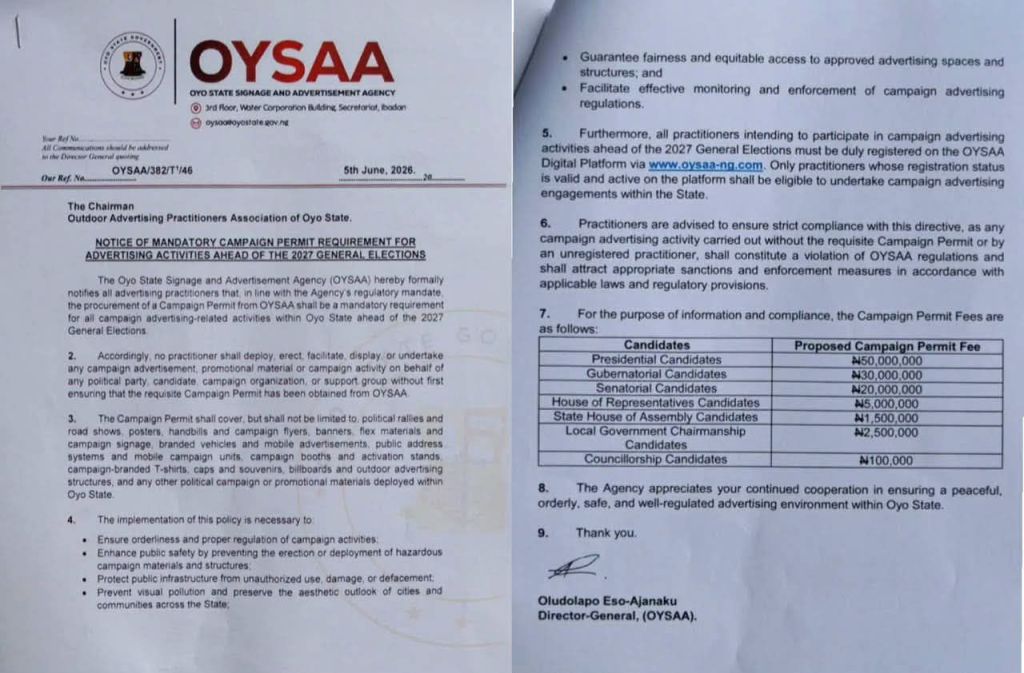
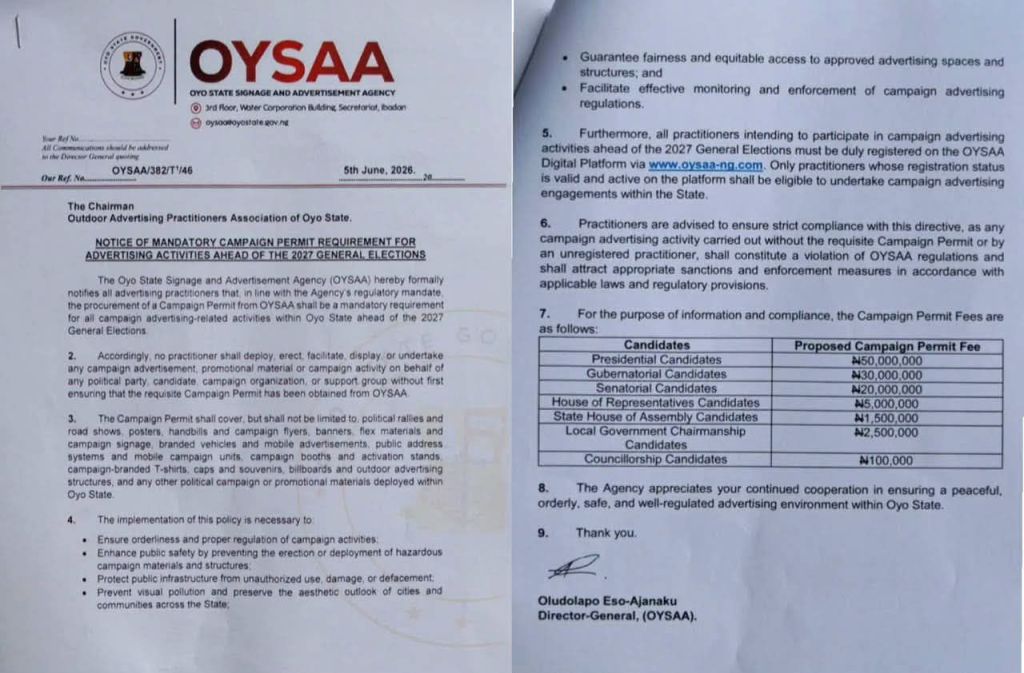
Under the new policy, presidential candidates are expected to pay ₦50 million, governorship candidates ₦30 million, senatorial candidates ₦20 million, House of Representatives candidates ₦5 million, House of Assembly candidates ₦1.5 million, local government chairmanship candidates ₦2.5 million and councillorship candidates ₦100,000 before campaign advertisements can be deployed. While governments have the authority to regulate outdoor advertising for reasons of public safety, aesthetics and orderliness, regulation must never become an instrument that places unnecessary financial barriers before political participation.
Democracy thrives on the free exchange of ideas. Political campaigns are not commercial ventures; they are essential democratic activities through which parties and candidates present their visions to the electorate. When the cost of communicating with voters becomes excessively high, the greatest casualties are not the political parties but the citizens whose access to competing ideas is diminished.
The timing of this policy, barely ahead of the 2027 general elections, is bound to attract public scrutiny. Many will inevitably wonder whether these charges are merely administrative or whether they could have the practical effect of making it more difficult for opposition parties and less financially endowed candidates to compete on an equal footing. Whether intended or not, any measure that appears to tilt the political playing field risks undermining public confidence in the electoral process.
One of the hallmarks of constitutional democracy is that every contestant should enjoy a fair opportunity to reach the electorate. Governments are expected to be impartial arbiters, not participants perceived to be erecting financial obstacles before political competitors. Excessive permit fees can discourage legitimate political expression, particularly among younger candidates, smaller political parties and grassroots movements that already operate with limited resources.
The Oyo State Government should therefore reconsider this policy. Reasonable regulatory charges are understandable, but fees should reflect the actual administrative cost of regulation rather than becoming a significant financial burden. Public institutions must always balance their regulatory responsibilities with the constitutional rights of citizens and political actors.
Ultimately, elections are won not through administrative hurdles but through the votes of the people. No amount of permit fees, bureaucratic requirements or regulatory obstacles can substitute for good governance or suppress the democratic will of the electorate.
The people of Oyo State desire change in 2027, and they will express that desire at the ballot box by voting for APC. They are tired of the current administration’s misgovernment, and they will show their grievances through the ballot. Democracy belongs to the people, not to regulatory agencies.
Those who believe that imposing burdensome campaign advertising fees will determine the outcome of the next election may be disappointed. The future of Oyo State will be decided by voters, not by permit invoices.
Draconian advert fees cannot stop the AP from seeking the mandate of the people. The strength of democracy lies in the freedom of citizens to choose their leaders, and that freedom should never be constrained by policies that are perceived as placing unnecessary financial obstacles in the path of political competition.


Leave a Reply